Something is genuinely wrong.
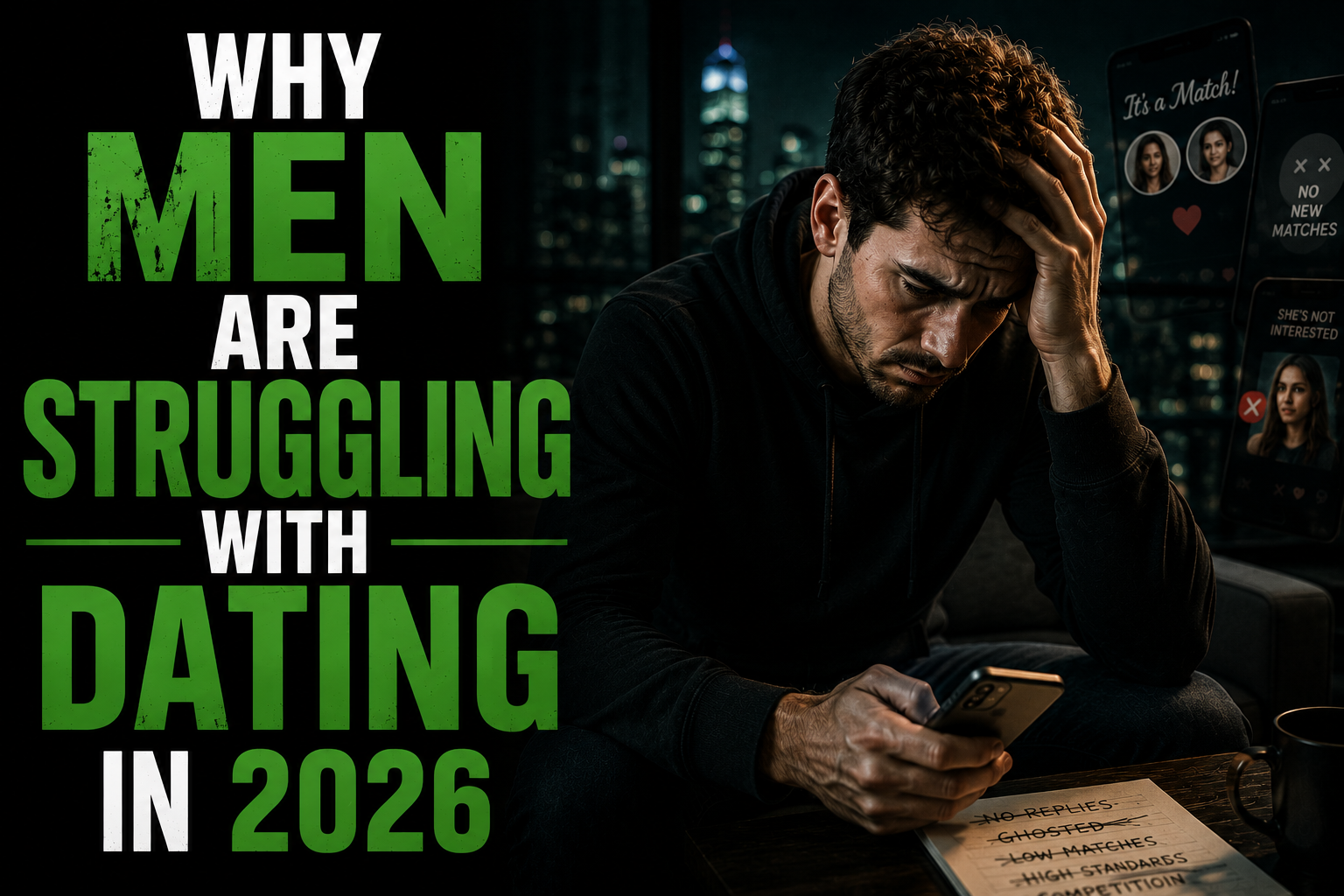
Not in a culture-war sense. Not as a talking point. In a measurable, observable, real-world sense: a significant portion of men are struggling with dating in ways and at rates that did not exist a generation ago. The data on male loneliness, on the growing percentage of men who have no romantic or sexual partner, on the widening gap between male and female dating outcomes, all of it points in the same direction.
This is a real problem. It deserves an honest diagnosis rather than either dismissal or outrage.
What follows is that diagnosis. Not politically convenient, not designed to confirm what you already believe. Just an honest look at what is actually happening and where the leverage is.
The Struggle Is Real
Let’s be clear about this first, because it gets contested in ways that are not useful.
Dating is harder for the average man in 2026 than it was for the average man in 2006. The data supports this. Male dating app results have deteriorated significantly as platforms have optimised for engagement over outcomes. Male loneliness statistics have increased consistently across Western countries over the past fifteen years. The percentage of men aged 18 to 30 who report having no romantic partner has more than doubled in a generation.
These are not feelings. They are numbers.
The experience behind the numbers is real too. Men who are making genuine effort, who are not obviously lacking in what they bring to a relationship, who are trying, and finding that the trying is not connecting to results in the way it feels like it should.
Validating that experience is not the same as agreeing with every analysis of why it is happening. And the analysis matters, because the wrong diagnosis produces the wrong response.
What Is Not the Cause

Start here, because the loudest explanations are usually the least useful ones.
Women are not the cause.
The narrative that women have become too selective, too entitled, too influenced by social media standards, is popular in certain corners of the internet and almost entirely wrong as a diagnosis. Women’s preferences have not changed in the ways this narrative suggests. What has changed is the environment in which those preferences are expressed, and that change affects men and women differently in ways worth understanding rather than resenting.
Blaming women for the male dating crisis produces exactly zero useful actions. You cannot change what women find attractive by being angry about it. You can change how you show up.
The culture is not the cause.
There is a version of this conversation that ends with “the culture is broken and there is nothing to be done.” This is the most comfortable conclusion and the least useful one. Culture is always changing. The men who do well in any cultural moment are the ones who adapt to it rather than the ones who complain that it should be different.
Apps are not the cause.
Apps are a contributing factor, and an important one that deserves its own section below. But men who only date via apps and wonder why their results are poor are looking at one variable in a multi-variable problem.
What Is Actually Happening

Three things, specifically. They interact with each other in ways that compound the problem.
Social skill atrophy.
This is the one that gets talked about least and matters most.
A generation of men has grown up with smartphones as the primary social interface. The skills developed through sustained, unmediated human interaction, reading body language, managing real-time social pressure, tolerating the ambiguity of live conversation, initiating contact in physical space, have had fewer opportunities to develop than at any previous point in history.
This is not a moral failing. It is an environmental outcome. If you spend your formative social years communicating primarily through text, you develop text communication skills. The skills that produce attraction in real-world interactions are different and largely separate.
The practical result is a generation of men who are, on average, less socially calibrated in live interactions than their predecessors, not because they are worse people but because the environment did not require them to develop those skills the way previous environments did.
Dating is a live social skill. Apps are not a substitute for it. They are a different medium with different mechanics, and the men who conflate competence on apps with competence in dating are measuring the wrong variable.
App dependency.
Dating apps have become the default for a large proportion of men, which would be fine if apps produced results commensurate with the time invested in them. For most men they do not, for the structural reasons covered elsewhere on this site.
The problem is not that men use apps. It is that apps have become a substitute for developing the in-person skills that produce consistent results, while simultaneously providing just enough intermittent reward (the occasional match, the occasional conversation) to keep men on the platform rather than building something more durable.
It is the slot machine problem applied to dating. Intermittent reinforcement is the most powerful conditioning mechanism that exists. Apps are specifically designed around it. And the men trapped in the loop of swiping, occasionally matching, rarely converting, are not weak or stupid. They are responding to a system that is designed to produce exactly that loop.
The absence of real guidance.
This is the cause that Dale talks about most, because it is the one most directly addressable.
Previous generations of men had, imperfectly and inconsistently, structures through which the social skills required for dating were transmitted. Communities, mentors, extended family contexts, environments where watching how older men navigated social situations was a natural part of growing up.
Those structures have largely dissolved. And what has replaced them is a combination of useless mainstream advice, ideologically compromised online communities, and a cultural silence around the specific challenges men face in this area.
Men are navigating something genuinely complex with almost no real guidance. The ones who figure it out do so through extended trial and error that takes years and costs real opportunities. The ones who do not find the red pill or the PUA world or simply give up.
The absence of real, honest, practically grounded coaching for men in this area is one of the most underaddressed problems in the male experience right now. It is also the one with the clearest solution.
Where the Leverage Is

Not in fixing the culture. Not in changing apps. Not in waiting for the environment to become more accommodating.
In the individual man. In the skills he develops, the inner game he builds, the real-world social practice he accumulates, the guidance he gets access to.
This is not a motivational statement. It is a practical one. The variable most responsive to deliberate effort, in the shortest time, with the most direct connection to outcomes, is the man himself. His presence. His calibration. His inner game. His willingness to develop real-world social skills rather than substituting app activity for them.
The men who are doing well in 2026’s dating environment are not doing well because the environment is kind to them. They are doing well because they have developed the things that produce results in any environment. Genuine confidence. Real social skill. The ability to approach and engage and connect in live situations.
Those things did not become less important when apps arrived. They became more rare. And rare, as always, is valuable.
The Honest Answer to Who Is to Blame
Nobody and everybody.
The technology companies that optimised for engagement over wellbeing. The cultural moment that dissolved the structures through which social skills were transmitted. The absence of honest, practical guidance for men navigating this. The individual man who chose the easy loop over the harder development.
All of those things are true simultaneously. Blame is not a useful frame because blame produces defensiveness rather than action. The useful frame is: given where things are, what actually moves them forward?
The answer to that question is always the same. The work. The real-world practice. The inner game. The coaching that shortens the learning curve. The community of men who are taking this seriously rather than explaining it away.
That is available. It has always been available. The environment is harder than it was. The work is the same.
The Starting Point
One conversation with Dale is the clearest first step for any man who is done explaining his situation and ready to change it.
Not politics. Not culture war. Not more content. A direct look at where you specifically are and what you specifically need to do to move forward.
Book Your Free Strategy Call →The environment is not going to fix itself. The work starts here.