It stings in a specific way.
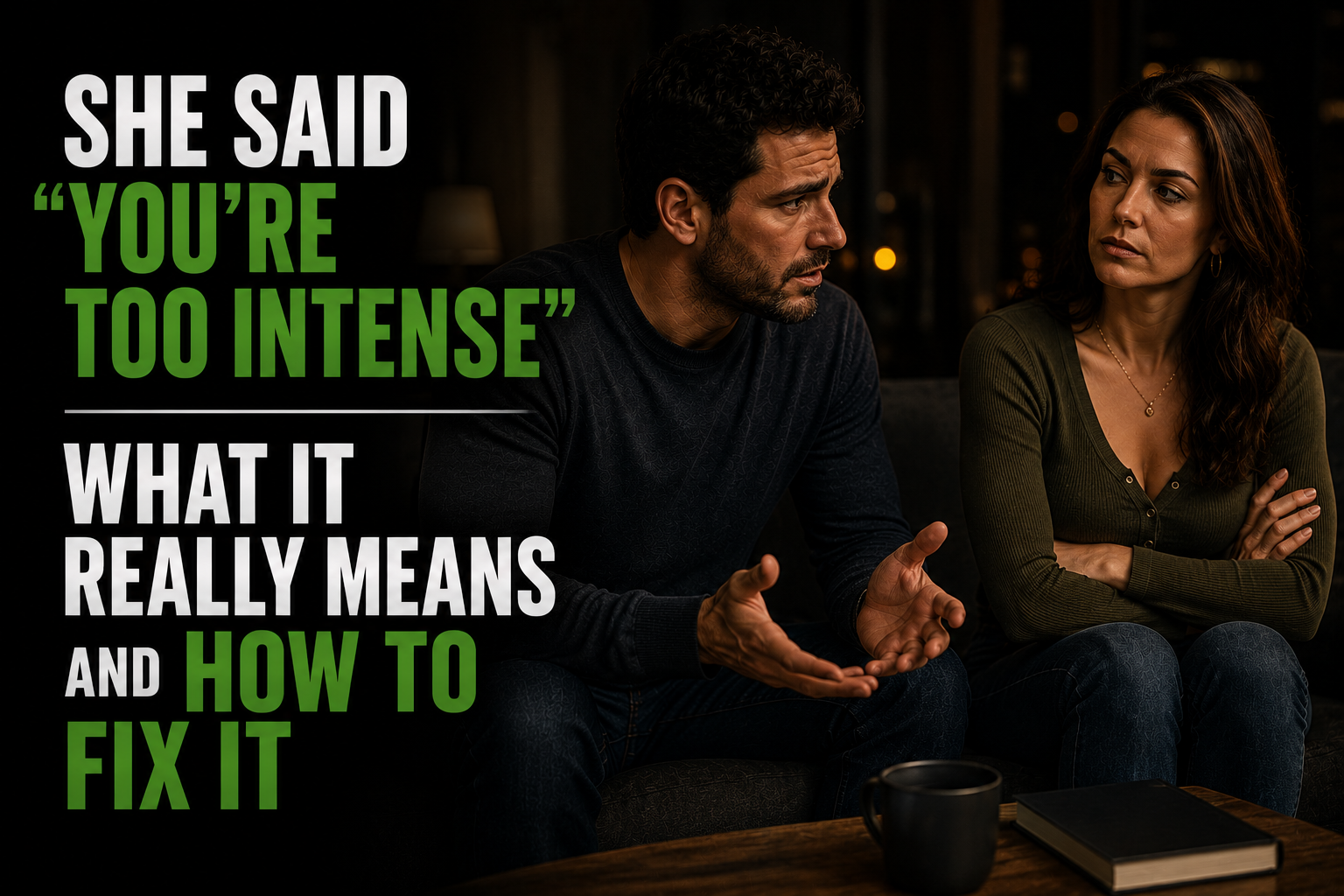
Not because she said you were boring or unattractive or unkind. She said you were too much. Too invested. Too serious. Too intense. And that particular feedback carries an odd quality because it seems to be criticising something that should be a strength. You care. You are engaged. You take things seriously. These are not supposed to be problems.
So what does it actually mean?
Here is the honest translation, without the softening that makes it feel better but leaves the pattern unchanged.
What ‘Too Intense’ Is Not
Start here because the wrong interpretation produces the wrong response.
It does not mean you are fundamentally unsuitable for relationships. It does not mean she wanted someone who cares less. It does not mean depth and seriousness are liabilities in dating generally. Plenty of deeply serious, emotionally engaged men are in relationships with women who value exactly those qualities.
What it means is specific to the early stage and the specific way the intensity was expressing itself. Which means it is fixable. Not by becoming someone lighter or more superficial. By understanding what was actually happening and adjusting it.
The Three Things ‘Too Intense’ Actually Signals
Over-Investment Too Early
Early dating has a pace. Not a game-playing pace, not a manufactured slow-burn designed to create interest. The natural pace of two people discovering whether they actually want to be together.
When a man front-loads his emotional investment, when he is operating at a level of intensity that belongs to month three of a relationship during the first two weeks, he creates a specific imbalance. She is still in the discovery phase. He has already arrived somewhere she has not been invited to yet.
This shows up as the text sent at 11pm that goes deeper than the length of the acquaintance justifies. The reference to the future that implies a certainty neither person has earned yet. The emotional availability at a volume that signals this person has decided something that the other person is still considering.
The result is not that she thinks he is a bad person. It is that she feels pressure. The pressure of someone who is further along than she is and expects her to catch up. That pressure creates distance even when the intention behind it was warmth.
The early stage of dating requires the patience to let things develop at a pace both people can actually be in. Not restraint for its own sake. Just the understanding that genuine depth takes time to build and cannot be shortcut by intensity.
Lack of Lightness
This one is subtler and often the more significant cause.
Intensity without lightness reads as heaviness. Every interaction is meaningful. Every exchange is significant. Every silence is examined. The energy of the whole thing is serious in a way that leaves no room to breathe.
Early attraction is supposed to be fun. Not shallow, not meaningless, but genuinely enjoyable in a way that includes laughter and playfulness and the specific lightness of two people who are still in the novelty of each other. When that lightness is absent, when every moment is weighted with significance, the interaction starts to feel like work rather than pleasure.
The man who is too intense in this way is not usually trying to be heavy. He is genuinely engaged and expresses that engagement with seriousness because seriousness is how he shows care. The problem is that seriousness, undiluted, removes the air from the room.
What is missing is not caring less. What is missing is the willingness to be light sometimes. To make a joke. To take something that is going well and not immediately make it more significant. To let an interaction be pleasant without needing it to also be deep.
Lightness is not superficiality. It is the quality that makes depth sustainable. Without it, even genuine connection becomes exhausting.
Neediness Masking as Depth
This is the hardest one to hear and the most important.
Some of what reads as intensity is not actually depth of feeling. It is anxiety expressing itself in the language of depth.
The man who texts constantly because he genuinely has so much to say, who needs to know where things are, who reads significance into every response and non-response, who wants the connection to be defined and certain and real, is not necessarily a man of unusual depth. He is sometimes a man whose anxiety is driving his engagement and whose depth is the cover story.
She cannot always tell the difference from the outside. But she can feel the quality of the interaction. The neediness underneath the intensity produces a specific kind of pressure, a sense that she is responsible for his emotional state, that withdrawing slightly would be a problem, that her engagement level is not entirely her choice because reducing it would cause something to happen.
That feeling is the thing she is naming when she says too intense. Not the depth. The pressure.
The honest internal question to sit with is: how much of my intensity in this situation was coming from genuine engagement with her as a person, and how much was coming from anxiety about whether she was interested in me?
If the honest answer has a significant anxiety component, the intensity is not a sign of depth. It is a sign of neediness in a language that sounds like depth. And the fix is not learning to express depth differently. It is addressing the anxiety underneath.
The Practical Adjustments

Not a personality transplant. Specific, targeted changes that preserve who you are while changing how it lands.
Match the pace of the other person.
Pay attention to where she is in the development of this thing rather than where you are. Is she still in the curious, getting-to-know-you phase? Stay there with her. Do not pull her forward by operating as if you are already further along. Let the pace be set by both of you rather than driven by your investment level alone.
Introduce lightness deliberately.
Make a joke. Tease her about something trivial. Let a moment be fun rather than meaningful. Not every interaction needs to move the relationship forward. Some of them can just be enjoyable. The ones that are just enjoyable are often the ones that actually build the most genuine connection, because she experiences being with you as pleasant rather than effortful.
Create space.
Not as a technique. As a genuine recognition that two people in early dating need room to miss each other slightly, to look forward to the next interaction, to have their own lives that the dating exists alongside rather than replacing. That space is not distance. It is the room that attraction requires to breathe.
Check what is driving the engagement.
Before the text, before the deep conversation, before the significant moment, a brief internal check: is this coming from genuine interest in her or from anxiety about where things stand? The former is fine, even in volume. The latter needs a different kind of attention than more expression.
The Underlying Thing

The capacity for depth, seriousness, and genuine investment is not the problem. It is an asset that has not yet found its right expression in the early stage of dating.
The men who are described as too intense in early dating and deeply compelling once a relationship is established are not different people at those two points. They are the same person who has learned to let the investment develop at the pace the connection can actually hold, rather than front-loading it in a way that collapses the space the other person needs to arrive in.
That patience is not suppression. It is the understanding that what you have to offer is worth waiting to express fully, and that expressing it prematurely does not show it to better advantage. It buries it under the pressure it creates.
The Guide That Helps With the Lightness Part
Flirting is the skill that introduces lightness into intensity. It is what prevents depth from becoming heaviness. Dale’s Free Flirting Guide covers the specific mechanics of playfulness, teasing, and the kind of light engagement that keeps early attraction alive without sacrificing the genuine quality underneath it.
Download the Free Flirting Guide →The intensity is not the problem. The lightness that balances it is what is missing. This is where to find it.