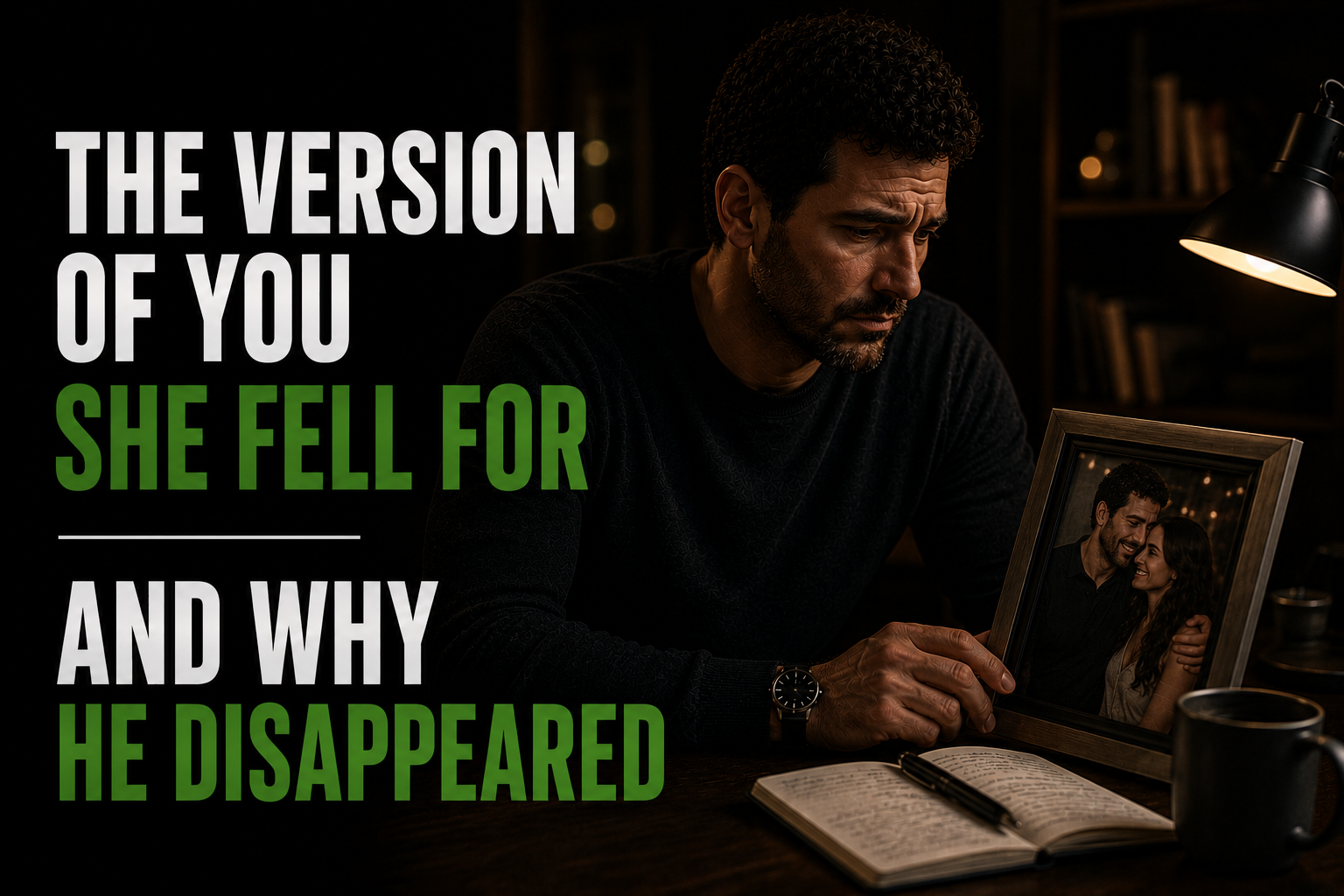
It has been longer than it should have.
You know that. You have probably been told that, by friends who mean well and have moved on to other conversations. You have told yourself that. The rational part of you understands that this relationship ended, that there were reasons it ended, that life continues and you are supposed to be continuing with it.
And yet.
She is still there. In the morning before the day starts. In the quiet moments that have not been filled with something else. In the specific way a song or a smell or a stretch of street brings it back without warning. In the dreams that you wake from slowly, where for a few seconds everything was different.
This is not weakness. It is not pathology. It is what happens when something real ends and the part of you that formed around it has not yet found a new shape.
This article is for that version of you. Not the one who has already moved on. The one who is still in it, longer than expected, wondering what is wrong with him and whether it is ever going to lift.
Why Some Breakups Are Different

Not all breakups affect people the same way. The ones that refuse to follow the expected timeline are usually ones where something specific was happening in the relationship that has not been fully understood.
The relationship was a significant attachment.
Attachment is not just emotional closeness. It is the specific neurological bonding that happens when someone becomes part of how you regulate your emotional world. When you are in a significant relationship, the other person becomes woven into your nervous system. Their presence, their predictability, their responsiveness to you, these things become part of how you stay stable.
When the relationship ends, the regulatory system loses a major component. The nervous system does not just feel sad. It feels destabilised. The grief is not only about missing her. It is about the loss of a structure that your whole system had organised around.
This is why the pain can feel disproportionate to what the rational mind thinks it should be. It is not disproportionate to what is actually happening at the neurological level.
The relationship ended before it felt complete.
Some breakups are clean. Both people know it was right. The ending, though painful, has a quality of resolution to it. These tend to move through in something closer to the expected timeline.
Others end without that resolution. She left without full explanation. It ended in conflict rather than clarity. There was something unfinished, a conversation not had, a thing not said, a possibility not fully explored, that leaves the mind returning to it because the mind is a completion-seeking system and this experience was not completed.
The obsessive returning is not irrationality. It is the mind trying to finish something that was interrupted.
The relationship confirmed something you were afraid was true.
This is the hardest one and the most important.
Some breakups are painful not only because of the loss but because of what the ending seems to mean. About you. About your lovability. About what you are capable of sustaining. About whether you are someone who gets chosen and kept.
When a breakup activates a pre-existing fear about your worth or desirability, the pain is not just the loss of the relationship. It is the apparent confirmation of something you were already afraid was true. That is a different and deeper wound than simple grief.
The obsession with the relationship in this case is often not about her specifically. It is about the verdict the ending seemed to issue.
What Is Actually Happening in Your Mind

The thoughts that return. The replaying. The checking her social media. The imagining conversations you will never have. The rehearsing of what you should have said or done differently.
This is not weakness. It is the mind’s attempt to process an experience it has not yet integrated.
The brain processes significant experiences through a combination of memory consolidation, emotional processing, and meaning-making. When a major relationship ends suddenly or without resolution, this process is disrupted. The mind keeps returning to the experience not because it is broken but because it is trying to complete the processing it has not yet been able to do.
The problem is that most of the behaviours that feel like processing, the replaying, the social media checking, the imagined conversations, are actually re-activation rather than processing. They bring the pain back to the surface without actually moving anything forward. They feel like dealing with it because they are engaging with it. They are not actually helping the wound close.
Real processing looks different. It involves sitting with the feeling rather than the thoughts. Allowing the grief to be there without turning it into a story about what it means. Understanding what the relationship actually was, not the idealised version the mind returns to, but the real version with its real dynamics and real reasons for ending.
The Idealisation Problem
This is the one that keeps men stuck longest and is the most important to name clearly.
In the aftermath of a significant breakup, the mind has a powerful tendency to idealise what was lost. The relationship that ended was complicated, imperfect, possibly genuinely wrong in important ways. The relationship the mind returns to is the best version of it. The early months. The high points. The feeling of being with her when things were good.
That version is not the thing that ended. It is a curated highlight reel that the mind is using as the object of grief.
This is why the pain seems disproportionate to what people who knew the relationship from the outside observed. They saw the full version. The mind is grieving the edited one.
The way through this is painful but important: the relationship needs to be held in its full reality. Not with bitterness or with deliberate focus on the bad, but with honest completeness. What was it actually like, day to day, at its most ordinary? What were the persistent difficulties? What were the ways it was not right, not in the final months when things were already ending, but throughout? What would it actually have cost to stay?
That honest accounting does not dishonour what was real. It allows the grief to attach to the actual thing rather than an idealised version that never quite existed.
The Forward-Focused Framework
Not a timeline. Grief does not run on a schedule. But a set of orientations that, when held consistently, allow movement rather than paralysis.
Process, do not replay.
The difference is subtle but important. Replaying is running the same thoughts again. Processing is sitting with the feelings beneath the thoughts. When you notice the mind starting to replay, the question to ask is not “what happened” but “what am I feeling right now, underneath this.” That question takes you to the actual material rather than the story about it.
Restore the honest picture.
Deliberately and regularly, hold the relationship in its full reality. Not to punish yourself or to decide she was bad. To ensure that what you are grieving is the actual thing rather than the curated version. The honest picture allows the grief to complete rather than continuing to attach to something that will not release it.
Rebuild the regulatory system.
The loss of a significant attachment disrupts the nervous system’s regulation. The path back is building alternative sources of the things the relationship provided: closeness, stimulation, purpose, the feeling of being known by another person. This does not mean replacing her. It means recognising that the nervous system has needs that were being met and finding genuine ways to meet them.
Understand what the ending seemed to mean.
If the breakup activated a pre-existing fear about your worth or lovability, that fear needs to be addressed directly. Not by finding a new relationship quickly to disprove it. By examining where the fear came from, what evidence actually supports it, and doing the inner game work that addresses it at its source.
Give the mind completion where possible.
The thoughts that return most obsessively tend to be the unfinished ones. The conversation not had, the thing not said. Where genuine completion is possible, where a real conversation with her would serve both parties and close something genuinely unresolved, it may be worth having. More often, the completion needs to happen internally: writing the letter that will not be sent, having the conversation with a trusted person, finding a way to say the thing that did not get said in a form that allows it to be said and released.
Why This Is Harder to Do Alone

Most men try to move through this privately. The cultural expectation is that you manage it, you do not talk about it, you get on with it. And that expectation produces men who are still carrying something significant years later because it was never properly processed.
The work described above, the honest accounting, the identification of what the ending meant, the inner game work on the fears it activated, is genuinely difficult to do without a guide. Not because you are incapable but because you are too close to it. The mind that needs to be examined is the same mind doing the examining. The patterns that need to be seen are the ones that are currently running, which makes them invisible from the inside.
Having someone who can see the pattern clearly from the outside, who can ask the right questions, who has done this work with enough men to know where the sticking points are and how to move through them, changes the speed and depth of what is possible.
Dale’s work with men going through this draws on both the practical framework for post-breakup recovery and the hypnotherapy-informed inner work that addresses what the ending activated at a deeper level. The combination produces results that solo processing and time alone rarely do.
Two Things for Right Now
The Free Breakup Guide covers the full framework for moving through this, the no-contact structure, the practical day-to-day steps, the signs that you are processing rather than replaying, and how to know when you are actually ready to move forward rather than moving before you are ready.
And if you want to work through this with someone who understands what is actually happening and can guide the process properly, the strategy call is where that starts. One honest conversation about where you are and what the right work looks like for your specific situation.
Both are available below.
Download the Free Breakup Guide →
Book Your Free Strategy Call →
You have been in this longer than you should have to be. The guide and the call are where that starts to change.