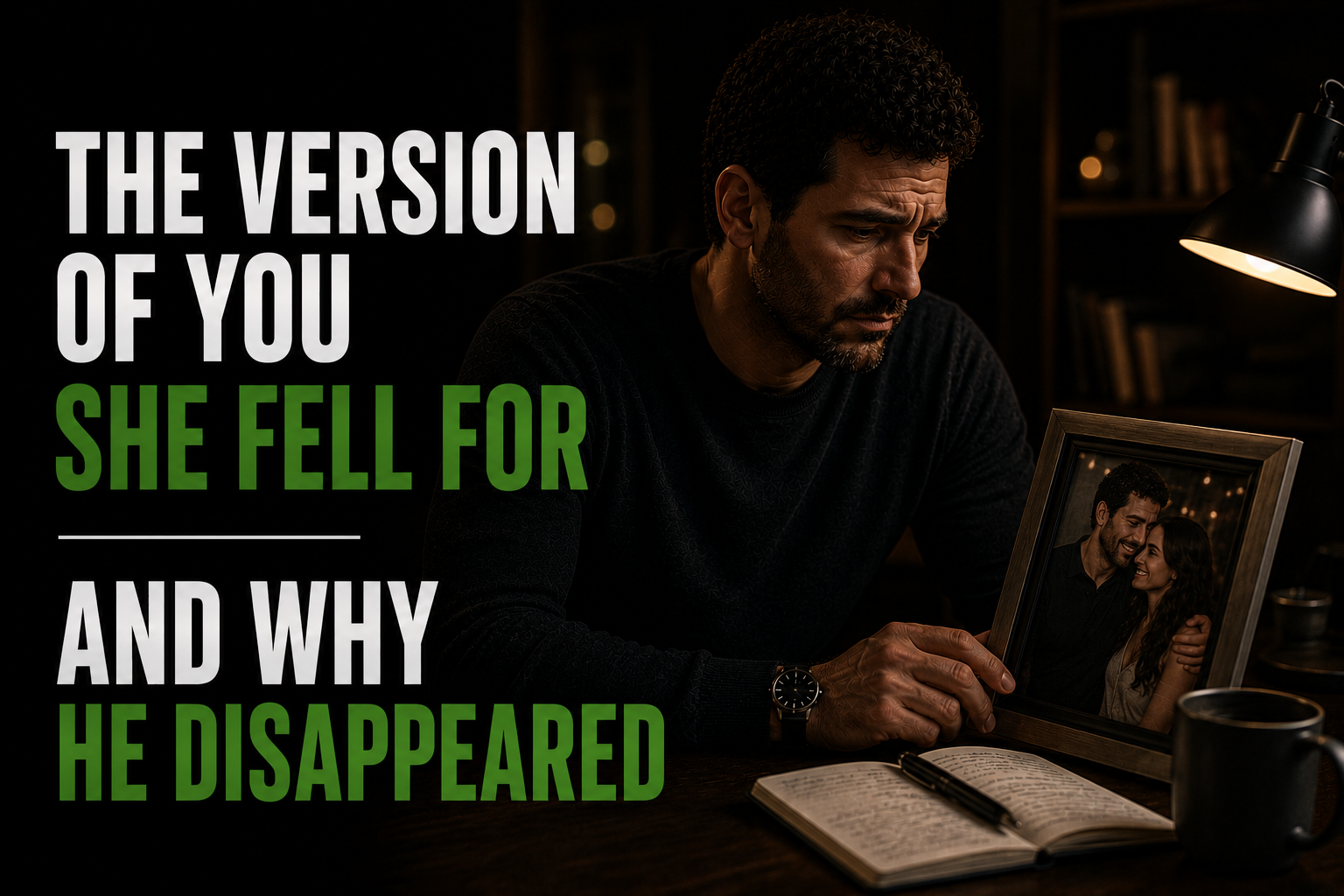
There is a version of you that she fell for.
He had direction. He had standards. He had a life that existed independently of her, with things he cared about and places he was going that had nothing to do with whether she approved of them. He was interested in her without needing her. He brought something to the relationship rather than being completed by it.
That man attracted her. Genuinely. The attraction was not a mistake or a misreading. It was a response to something real that was there.
And then, over months or years, quietly and without any conscious decision, he drifted.
How It Happens
The drift is not dramatic. That is why it goes unnoticed until the damage is visible.
It begins with comfort, which is not itself a problem. Comfort is supposed to follow the early intensity of a relationship. The anxiety reduces. The need to perform reduces. You relax into each other. This is healthy. This is what a developing relationship is supposed to feel like.
The problem is what gets relaxed along with the anxiety.
The man who was going to the gym consistently stops going as consistently because she is home and being with her feels better than working out. The man who had his own social plans starts cancelling them because it is easier to stay in. The man who had opinions and direction and things he was building starts deferring, a little more each month, because deferring produces less friction than maintaining the self he had when they met.
None of these are dramatic choices. Each one is small. The problem is the compound effect over time. Eighteen months of small deferrals and cancellations and relaxations of the standards he held before produces a man who is recognisably different from the one she chose.
He is more available. More accommodating. More centred around her preferences and her schedule and her world. He has made himself smaller in ways he calls consideration and partnership but which are, if he is honest about it, a slow erosion of the self she was attracted to in the first place.
What She Is Experiencing

This is the part that most men only understand in retrospect, after the relationship has already changed.
She is not experiencing a man who loves her more than he did at the start. She is experiencing a man who has gradually replaced the version of himself she chose with a version that is more domesticated, less directional, and harder to respect.
Respect is the key word. Not love. The emotional attachment can remain and often does. But respect, which in this context means the specific regard that comes from being with someone who has their own shape, their own standards, their own life that does not revolve entirely around you, quietly erodes as the man erodes.
And with the respect goes something else. The specific attraction that is connected to seeing someone as a person rather than as a function in your life. The drift from partner to comfortable companion is one of the most common and least discussed causes of relationships losing their charge long before they end.
She may not be able to name what changed. She knows something has. She might describe it as feeling like roommates. Like something is missing. Like she loves him but is not in love with him in the way she was. These are the words people reach for when they cannot precisely name the drift.
What is missing is him. The version of him she chose.
The Specific Ways Men Disappear
He stops having standards for himself.
The fitness, the discipline, the ambitions he had before the relationship either stall or disappear. Not immediately. Over time. The relationship becomes the achievement and the striving that was part of what made him attractive slows because the urgency that produced it has reduced.
She fell for a man who was building something. Over time she is watching a man who has arrived, which is a different thing entirely. Arrived is static. Building is alive.
He stops leading.
In the early stages he made decisions. He planned things. He moved things forward rather than waiting to see what she wanted. Over time, in the interest of harmony or out of habit or out of the slow shedding of the confidence that came from having had to earn her, he stops leading.
The decisions get deferred to her. The plans stop being made. The relationship starts to be shaped by her energy rather than by both of them together. And she begins to carry a weight she did not sign up to carry, which produces exactly the kind of resentment that neither person was expecting.
He stops maintaining his own world.
The friendships that were maintained before the relationship get less attention. The interests that were genuinely his, not shared interests, his, narrow. The social life that made him an interesting person to be with shrinks to a point where the relationship is the primary container for everything.
That is not romantic. It is, for the person who becomes the container, quietly suffocating.
He stops being someone she has to hold on to.
In the early stages there was a quality of not taking the relationship for granted. Some natural uncertainty that kept both people investing. Over time, the certainty of the commitment replaces the investment. He stops bringing his best because his best is no longer required to maintain what he has.
She notices. Not as a thought. As a felt shift in how it feels to be with him.
Why This Is Not Her Fault
Worth saying clearly because the temptation, when a relationship loses its charge, is to look for someone to blame.
She did not change the rules. She is responding to a change in him with a natural and honest response. The attraction that was there for the original version of him has reduced as the original version of him has reduced. This is not fickleness or shallowness. It is the honest operation of what attraction actually is.
He changed. She responded to the change. The attribution of the problem to her is the wrong diagnosis and it produces the wrong response.
The right diagnosis is the drift. The right response is addressing it.
The Recovery Path

Not performing the version of himself she fell for. Recovering it.
The distinction matters. Performing is external and temporary. Recovery is internal and lasting.
Reclaim the standards.
What were the standards he held before the relationship that he has let slide? The physical standards. The professional ones. The standards for how he spent his time and who he spent it with. Pick the most significant one and begin restoring it. Not to impress her. Because it was part of who he actually was and it is worth being that person again.
Rebuild the independent life.
What existed before the relationship that the relationship quietly absorbed? The friendships. The interests. The things he did without her. Begin restoring those, not as a statement about the relationship but as a genuine reinvestment in himself as a person who exists beyond it.
Start leading again.
Make a decision without asking her preference first. Plan something and invite her into it rather than asking what she wants to do. Not controlling, not dismissive of her preferences. Just the natural reassertion of a man who has direction and is not waiting for permission to follow it.
Stop making her responsible for his inner life.
The drift into making her the centre of his emotional world is the root of most of what followed. The recovery involves building the inner stability that means he does not need her to be a certain way in order to feel okay. That work is the inner game work. It is the foundation everything else rests on.
If the Relationship Is Still Intact
The most important thing to understand is that she is not lost. She responded to the original version of him. That version is not gone. It drifted, which means it can be recovered. The recovery, when it is genuine rather than performed, tends to change the relationship in exactly the direction both people wanted.
Women do not fall out of love with men who recover themselves. They tend to feel the recovery before they can articulate what changed. The shift in his energy. The direction he has again. The sense that he is someone to be with rather than someone she is responsible for.
The recovery is for him. The relationship is likely to benefit.
If the Relationship Has Already Ended
The same recovery is the work. Not to get her back. To become the version of himself that he wants to be, that he was before he drifted, that he is capable of being and is worth being regardless of whether this particular relationship resumes.
The man who recovers himself after a relationship in which he drifted is the man who does not repeat the pattern in the next one. Not because he has made a rule about it. Because he has done the work that makes the drift less likely. Because he knows where it starts and has the inner game foundation to catch it early.
The Conversation That Starts the Recovery

The strategy call with Dale is where the drift gets named specifically and the recovery path gets mapped to your situation.
Where it started. What it cost. What the inner game work looks like to address it. And what a relationship, current or future, looks like when it is built by a man who has not lost himself in it.
One conversation. The clearest picture you will have had of what actually happened and what comes next.
Book Your Free Strategy Call → The call is where the recovery starts.