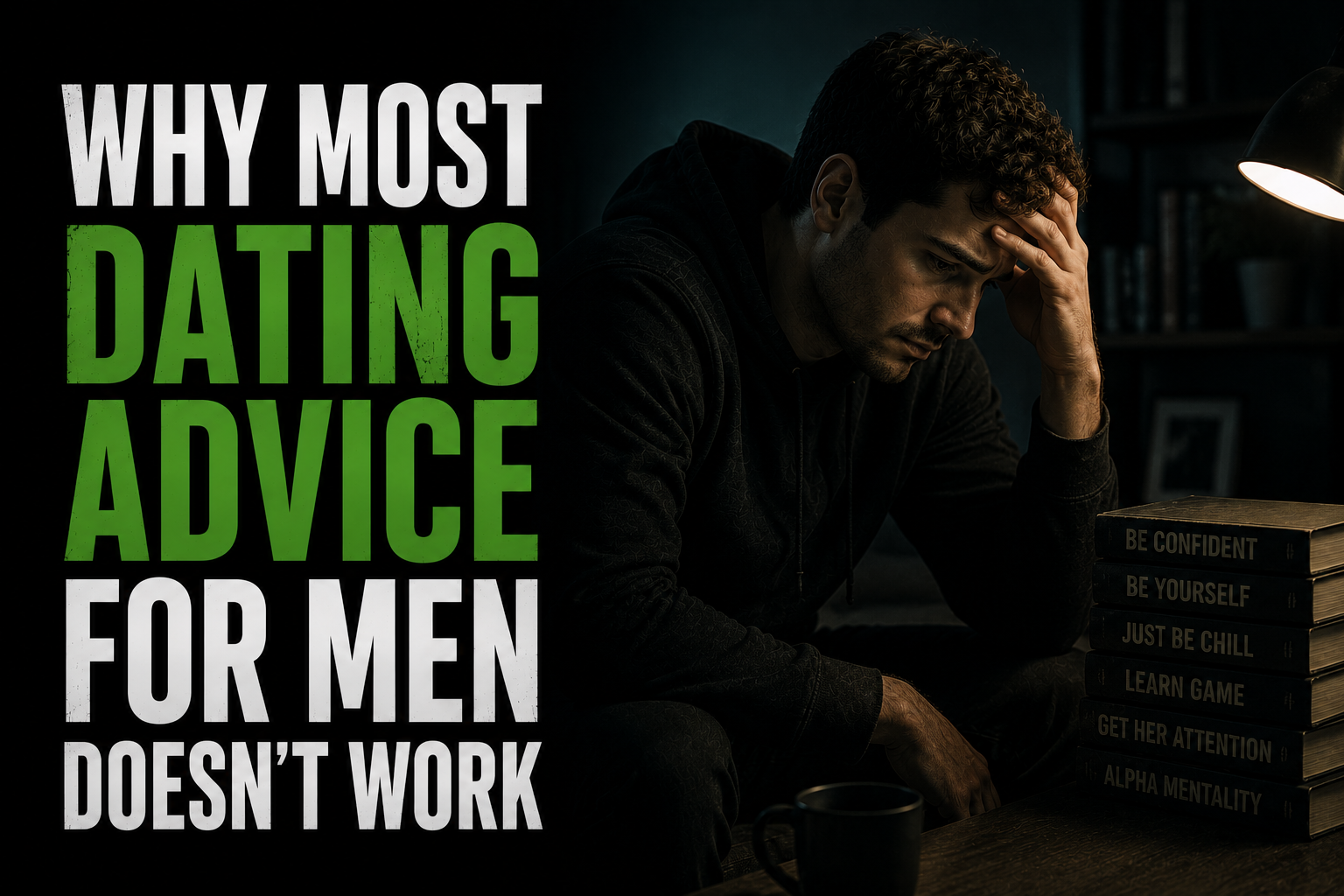
If you have spent any meaningful time consuming men’s dating content online, you have been exposed to an enormous amount of advice. Some of it contradictory. Some of it plausible-sounding but practically useless. Some of it actively making the problem worse while appearing to address it.
The market for this content is vast and largely unregulated. Anyone can position themselves as a dating coach. Anyone can make a video, write an article, build a following, and sell a course. The incentive structure rewards content that gets clicks and generates sales rather than content that produces real change in the men consuming it.
The result is an ecosystem where the most visible advice is often the least useful, and where men who spend years consuming it sometimes end up less capable of genuine connection than when they started.
This is a problem worth naming specifically. Not to be cynical about the whole space, there is genuine value out there, but to give men the diagnostic tools to know the difference.
The Manipulation Tactics Category
This is the largest category and the most damaging.
It includes negging, false time constraints, jealousy plotlines, manufactured scarcity, psychological pressure techniques borrowed from sales and applied to human connection. The underlying assumption of all of it is that attraction is a response that can be triggered by the right sequence of stimuli, regardless of who is doing the triggering.
The techniques sometimes work in the short term. Intermittent reward schedules do create attachment. Manufactured social proof does influence initial perception. The psychology underneath these techniques is real.
The problem is the model it produces in the man who applies them.
He begins to see every interaction as a game to be won rather than a connection to be made. He relates to women as targets rather than people. He invests energy in learning to manipulate rather than in becoming genuinely more attractive. And the results, even when they arrive, are built on a foundation that collapses as soon as the technique is no longer running.
More damaging than the results is what it does to the man himself. Men who spend years in the manipulation tactics world consistently describe a specific kind of emptiness. They got better at the game. The game stopped feeling like it was connected to anything they actually wanted.
The Scripted Openers Category

Less harmful than manipulation tactics but more pervasive and more immediately obvious in its failure mode.
The scripted opener problem is simple: scripts are written for hypothetical situations and real situations are specific. A line that works in one context, with one woman, in one emotional register, does not transfer to the next situation with the reliability that scripts imply.
More importantly, delivering a scripted line requires a degree of internal split that women pick up on immediately. Part of you is saying the words. Another part is monitoring whether they are landing. A third part is ready to move to the next scripted element depending on the response. The presence that makes interaction feel real is impossible when you are running this kind of parallel processing.
Women do not always know they are hearing a script. But they almost always feel the quality of the interaction that scripts produce: slightly thin, slightly off, like they are in a conversation with someone who is performing rather than being.
Scripts teach men to deliver lines rather than have conversations. The skill being developed is not the skill that produces real results.
The Alpha-Male Posturing Category
The most visible category right now and the one with the most elaborate theoretical framework behind it.
The alpha male model teaches men to perform dominance. To never show weakness. To maintain a frame of superiority in every interaction. To view softness or uncertainty as liabilities to be eliminated rather than human qualities to be integrated.
The theory is that women are attracted to dominance and therefore performing dominance will produce attraction.
The observation is partially correct. The conclusion is wrong.
Women do respond to genuine confidence, groundedness, and the kind of certainty that comes from a man who knows himself. None of those things are the same as performed dominance. And the performance of dominance, as distinct from the real thing, produces something women can feel clearly: a man who is trying very hard to appear strong, which is itself a kind of weakness.
The alpha posturing category also produces men who are increasingly difficult to be in a genuine relationship with. Because the performance cannot be maintained indefinitely. Because relationships require vulnerability and the alpha male framework specifically prohibits it. Because the woman eventually encounters the man behind the performance and finds someone who has spent years building a wall rather than a foundation.
The “Just Be Confident” Category
The most useless category, which is saying something given the competition.
“Just be confident” is advice in the same way that “just be taller” is advice. It names the desired output without providing any mechanism for producing it. It is the advice equivalent of pointing at where you want to go without giving any indication of how to get there.
Its prevalence in dating advice is a symptom of coaches who understand the destination but not the journey. Confidence is real. It is attractive. It is also the output of a specific internal state that is produced by specific inner work, not something you can simply choose to have by deciding to.
Men who receive this advice and cannot follow it are not failing because they are weak. They are failing because they have been given an output and told to produce it without any information about the process that produces it.
The “Volume and Hustle” Category
The approach that says: the solution to poor dating results is more approaches, more swipes, more volume, more hustle. That results are a numbers game and the answer to not enough results is more numbers.
This is partially true and mostly harmful as a framework.
It is partially true because social skill does require reps, and men who never approach will not develop the skill. But raw volume without honest self-assessment and adjustment produces the same approach over and over again at higher frequency. If the approach is not working, more of it does not fix it.
The volume and hustle frame also tends to produce a specific kind of objectification, not malicious but structural, that comes from treating interactions as units in a numbers game rather than as encounters with specific people. Women sense this. The man who is running through his approach quota is communicating something very different from the man who is genuinely interested in the person in front of him.
More importantly, the volume frame points men away from the inner game work that would actually change their results. You do not need more approaches. You need better quality in the ones you take. Quality comes from the internal state, not the volume.
What Honest Coaching Actually Looks Like
The specific, identifiable difference between the categories above and the approach that produces real results:
It starts from the inside. Not with techniques for the outside. The inner game is not a supplement to the practical skills. It is the foundation without which the practical skills do not hold up.
It does not promise what it cannot deliver. Real change in dating takes time. It is not six weeks. It is months of consistent work, producing gradual and then accelerating change. Any coach who tells you otherwise is optimising for your purchase, not your result.
It treats you as a person, not a client profile. The work is tailored to your specific patterns, your specific starting point, your specific gaps. Not a generic programme delivered at scale.
It produces results that hold under pressure. Not techniques that work when you are relaxed and fall apart when you are anxious. Real internal change that shows up consistently because it is who you have become rather than a set of behaviours you are maintaining.
And it is honest when something is not working. Real coaching involves real feedback. Not endless validation that you are doing great and just need to keep buying the programme.
How to Tell the Difference

Before you consume any more dating content, ask these questions.
Is this teaching me techniques to use on women or helping me become someone women are genuinely attracted to? The first is a surface intervention. The second is the real work.
Does this require me to pretend to be someone I am not? If the advice requires a persona, it is not building anything. It is borrowing a costume.
Is the person giving this advice someone who has clearly done real inner work themselves, or are they selling confidence while clearly being driven by something other than genuine security? The subtext of how a coach communicates reveals more about their inner game than any claims they make.
Does this feel like it is designed to help me or to keep me consuming? The incentive structure of most content is continued engagement. Real coaching has an exit point: the client no longer needs the coach.
Dale’s Approach
This is what the rest of this site is built on. Inner game first. Real experience behind every framework. Honest assessment over comfortable validation. Results that hold because they are built into who you have become.
The strategy call is where Dale gets a direct picture of your situation and tells you honestly what he sees and what the work looks like. Not a pitch for a programme. A diagnostic.
Book a Free Strategy Call With Dale → One conversation with someone who is not trying to keep you consuming. Just trying to help you change.