Most men think attraction starts when they open their mouth.
It does not. It starts the moment they enter a space. Sometimes before they have been consciously noticed at all.
The body is broadcasting continuously. Posture, movement, spatial behaviour, eye contact, pacing — all of it is being processed by everyone around you, mostly below the level of conscious awareness, and producing felt responses that set the frame for every interaction before a single word is exchanged.
Dale has watched this play out in the field more times than he can count. The man who walks into a room a certain way and is approached before he has done anything. The man who stands a certain way and is invisible despite being objectively better-looking than the man next to him. The signals are real, they are readable, and they can be changed deliberately.
Here is the full breakdown.
Posture: The Foundation Everything Else Builds On
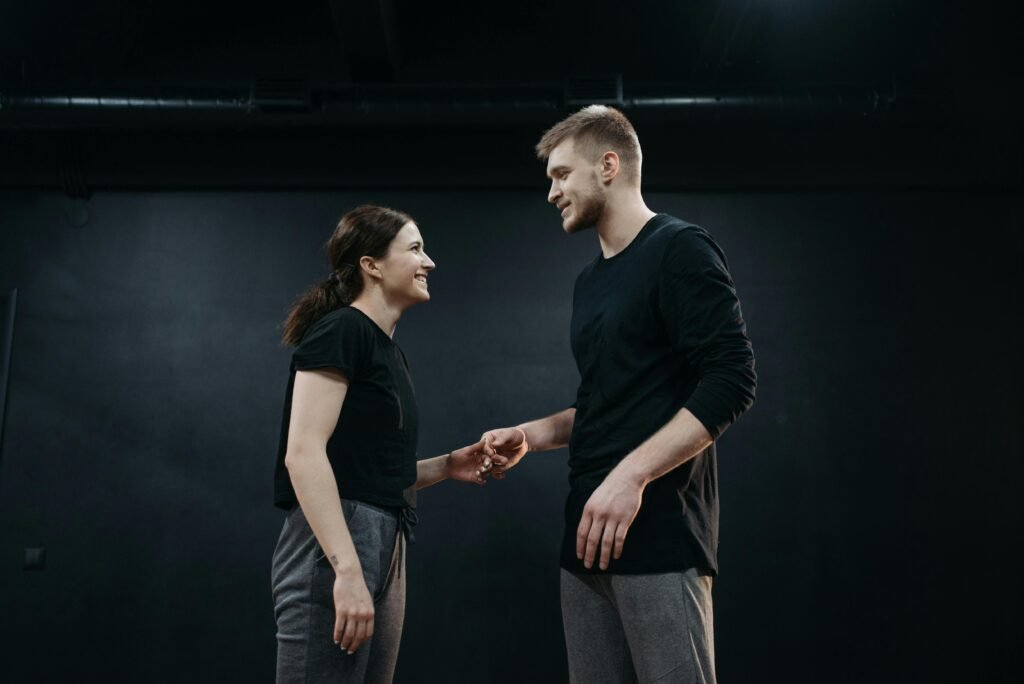
Posture is the first and most important signal because it is always present. You cannot turn it off. Which means it is either working for you or against you continuously.
What poor posture communicates at the subconscious level is not a moral judgement but a status assessment. Rounded shoulders, collapsed chest, head forward, all of these read as low confidence and low status to a nervous system that is making rapid social assessments. Not because anyone has decided this consciously. Because the brain has learned to associate these postural patterns with certain internal states and it makes that association automatically.
Good posture communicates the opposite. Not rigidity. Not the military brace that looks as uncomfortable as it is. Just a natural upright alignment where the spine is long, the shoulders are back and relaxed, and the chest is open rather than protected.
The easiest cue Dale gives men in the field: imagine a thread attached to the top of your head, pulling gently upward. Not yanking you into a strained position. Just creating a little length in the spine. Everything else tends to fall into place from there.
The drill: For one week, every time you sit down or stand up, check in with your posture. Not obsessively, but as a consistent reset. The goal is not to maintain perfect posture every second. It is to raise your baseline so that your default is closer to where you want it.
Eye Contact: The Most Underused Signal in Dating

Dale calls eye contact the great differentiator. Because the gap between how most men use it and how it should be used is enormous, and the impact of closing that gap is immediate and significant.
Most men use eye contact anxiously. They make it briefly, look away, make it again, look away. The overall effect is a kind of scanning that reads as either nervous or evasive. Neither produces attraction.
The other failure mode is the opposite: fixed, unblinking eye contact that is trying so hard to be dominant that it crosses into uncomfortable. That is not confidence. That is tension wearing confidence’s face.
What actually works is steady, relaxed eye contact with natural breaks. Hold it for a beat longer than a purely social interaction would require. Not staring. Just comfortable. Unhurried. The kind of eye contact that says I am here, I see you, and I am in no particular rush to look away.
In a crowded room, this quality of eye contact across a distance is one of the most powerful signals you can send without moving a muscle. Women who receive it, who feel seen rather than scanned, respond in ways that are unmistakable.
The drill: In ordinary social interactions this week, practise holding eye contact for one second longer than feels comfortable before looking away. Not with every person in every moment. Just as a regular practice that raises your baseline. The discomfort fades quickly. The skill builds fast.
Spatial Awareness: How You Occupy Space
This one gets overlooked because it is subtler than posture or eye contact. But Dale consistently finds it is one of the most immediately changeable signals with one of the biggest impacts.
Most men make themselves small. They stand with their feet close together, elbows in, shoulders slightly forward, taking up as little space as possible. This is a deeply ingrained response to social environments where occupying space feels presumptuous.
Men who read as high status and confident tend to do the opposite. Not aggressively, not in a way that crowds other people. They just take up the space that is available to them naturally. Feet shoulder-width apart or slightly wider. Arms loose rather than crossed or pressed to the body. Weight distributed rather than shifted to one hip in a way that signals readiness to leave.
When standing still, this looks like a man who is comfortable exactly where he is. He is not preparing to escape the situation. He is not performing ease while communicating tension. He is just there, fully occupying his space, with no particular need to shrink.
Dale noticed this pattern early in his field work: the men who attracted the most attention in social environments were almost always the ones who took up the most physical space in a relaxed and natural way. Not the loudest. Not the best-looking. The most settled.
The drill: Next time you are standing in a social environment, check your feet. If they are closer together than shoulder width, move them. Let your arms hang naturally rather than crossing them or stuffing your hands in your pockets. Notice what shifts, internally and in terms of how people respond.
Pacing: The Speed Signal Nobody Talks About

Everything about how you move has a pace. How quickly you walk. How fast you turn your head. How rapidly your hands move when you speak. How quickly you respond to something that happens around you.
High-status, confident individuals tend to move at a slower pace than anxious ones. Not lethargic. Deliberate. Like there is no particular urgency, like the world will wait a moment for them to get there.
Anxious people move fast. Fast responses, fast movements, fast glances. The nervous system is set to high alert and the movement reflects it. This pace broadcasts discomfort clearly to everyone around you, even when the content of what you are saying is fine.
Dale spent time specifically working on his own pacing in the field after noticing that his results on days when he was rushed or stressed were consistently worse than on days when he was unhurried, regardless of what he was actually saying. The physical pace was setting the frame.
The practical adjustment is simple but requires consistent attention: slow everything down by about twenty percent. Your walk. Your head movements. Your response time in conversation. The moment between someone speaking and you replying.
That pause, that beat of unhurried consideration before you respond, is one of the most powerful pacing tools available. It reads as thoughtfulness and confidence simultaneously. It also, as a practical benefit, gives you more time to say something worth saying.
The drill: Walk slower today. Not conspicuously slower. Just consciously slower than your default. Notice what happens to your internal state when you do. The physical pace and the mental pace are connected more directly than most men realise.
The Walk
Everything described above shows up most visibly in how a man walks. Which makes the walk both the best summary of where your body language currently is and the highest-leverage single thing to change.
Dale has watched men walk into venues hundreds of times. The difference between a man whose walk signals confidence and one whose does not is immediately readable from thirty metres away and produces a completely different social response before any interaction begins.
What a confident walk looks like: upright posture, relaxed shoulders, an unhurried pace, feet making contact with the ground rather than shuffling, a slight natural sway that comes from relaxed hips rather than a rigid locked stride, eyes at eye level rather than looking at the ground.
What it does not look like: a performance. The men whose walks produce the strongest response are not walking in a way that is obviously studied. They are walking in a way that is simply relaxed and deliberate, as if they have somewhere to be and are comfortable about getting there in their own time.
The walk is the advance signal. It sets the frame that every subsequent interaction happens inside. Get it right and you enter conversations already ahead of where most men start.
The drill: Film yourself walking. Seriously. Thirty seconds of footage of yourself walking normally, when you are not thinking about it, is more instructive than any amount of description. Watch it back. You will see immediately what is working and what is not. Then film yourself again after a week of deliberate practice and compare.
Putting It Together: The Field Test
These signals work individually. They work significantly better in combination, because the overall impression a person creates is the sum of all of them simultaneously.
Dale’s recommendation for men who want to put this into practice: pick one signal per week. Not all five at once. One. Work on it consistently for a week until it starts to become natural rather than effortful. Then add the next one.
The sequence he suggests: posture first, because it is the foundation and it affects everything else. Pacing second, because slowing down makes the other signals easier to access. Eye contact third. Spatial awareness fourth. The walk, which integrates all of the above, last.
By the end of five weeks, you are not managing five separate things. You are moving through the world as a man whose body language is working for him rather than against him. And the conversations that follow will be starting from a different place than they are now.
Where Live Coaching Comes In
Reading about body language produces understanding. Having someone watch you in a live environment and give you real-time, specific feedback on what you are actually doing produces change.
Dale’s Premium community includes live coaching sessions where exactly this kind of targeted, in-person feedback is available. Not generic advice. Specific observation of your specific patterns with precise adjustments.
If you want to accelerate what this article describes, that is where to go.
Join the Dating Academy for Live Coaching → The framework is here. The feedback that makes it stick is inside.