I want to be straight with you about something before this article goes any further.
When most people hear the word hypnotherapy in the context of dating coaching, one of two things happens. Either they get curious in a slightly sceptical way, wondering if this is going to be some kind of pseudoscience dressed up in professional language. Or they get genuinely interested because they have tried the conventional approaches and something still is not shifting.
If you are in the first group, stay with me. This is not woo. There is nothing mystical happening here. What I am going to describe is grounded in how the brain actually works, and the evidence behind it is considerably more solid than most of what passes for dating advice online.
If you are in the second group, you probably already sense that the problem goes deeper than technique. You are right. And this is the article that explains why.
How I Got Into Hypnotherapy
It did not start as a plan.
I was already working in the coaching space when I started my hypnotherapy training. At that point the two things existed in separate compartments in my mind. Coaching was practical and external. Hypnotherapy was clinical and internal. I did not immediately see the connection.
The training changed that.
What hypnotherapy training gives you, at its core, is a precise map of how the subconscious mind works. How beliefs form. How emotional responses get wired in. How the patterns that feel like personality are often just early conclusions that have never been revisited. How the part of the mind that operates below conscious awareness is running most of the show, most of the time, without the conscious mind knowing it is happening.
I spent months learning that map. And about halfway through the training, I had a realisation that reframed everything I had been doing in coaching.
Every pattern I was seeing in the men I worked with, the approach anxiety, the neediness, the emotional guardedness, the inability to hold attraction beyond the first few weeks, every single one of them was a subconscious pattern. Not a skill gap. Not a knowledge deficit. A pattern, with a source, operating below the level where conventional coaching reaches.
I had been trying to fix subconscious problems with conscious solutions. It explained a lot.
What Hypnotherapy Actually Is

Because the misconceptions are real and worth clearing up directly.
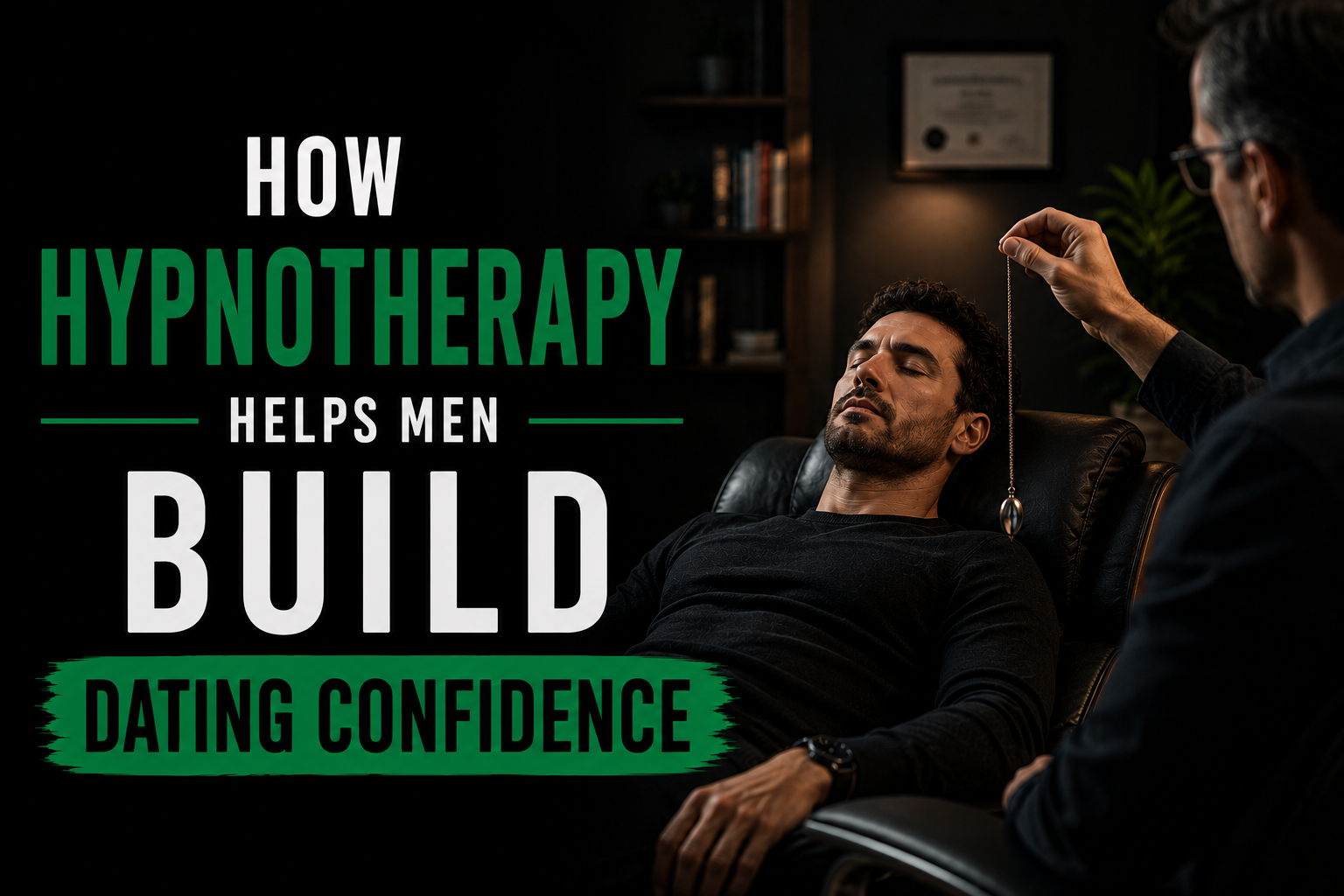
Hypnotherapy is a structured method for working with the subconscious mind. In a clinical context it involves guiding a person into a deeply relaxed, focused state, not unconscious, not out of control, but relaxed enough that the conscious mind’s habitual defences are quieter than usual. In that state, the subconscious is more accessible. Beliefs can be examined. Patterns can be addressed at the level where they actually live. New associations can be formed that the conscious mind, with its ingrained habits, would normally resist.
It is not magic. It is not mind control. The person in hypnotherapy is always in control and always aware. What changes is the depth of access, which changes what is possible in the work.
In the context of how I use it in coaching, it does not always mean formal hypnotherapy sessions. More often it means that the training gives me a fundamentally different way of listening, a different set of questions, a different diagnostic lens. When a man describes his behaviour, I am hearing the pattern underneath it, the belief that is driving it, and the emotional history that formed the belief. That level of hearing is what the training produced.
And for some clients, the work does go into more direct subconscious techniques. Visualisation, reframing, parts work, timeline work. The specific tool depends on what the pattern needs. But all of it is grounded in the same understanding: the change needs to happen where the pattern lives, not where it shows up.
The Moment It All Connected
There was a specific client early in the integration of this approach who made the connection undeniable.
He came to me with what looked, on the surface, like a classic approach anxiety problem. He was intelligent, self-aware, reasonably good-looking, had his life together. He understood, intellectually, that approaching women was not dangerous. He could articulate exactly why his fear was irrational. And he still could not do it.
We had been working on the external mechanics for a few weeks and he was making some progress, but it was effortful and inconsistent. Every time he got close to a genuine breakthrough, something pulled him back.
I shifted the work. Instead of working on the approach, I started working on the belief underneath it. We went looking for where that pattern came from. What situation, early in his life, had taught his nervous system that putting himself forward was genuinely dangerous.
We found it. It was specific, it was old, and when he saw it clearly, something visibly shifted in him. Not dramatic. Quiet. Like a knot loosening.
The following week he approached four women without what he described as the usual noise in his head. Not because he had practised more. Because the thing that was producing the noise had been addressed at its source.
That was the moment I stopped thinking of hypnotherapy and dating coaching as separate things.
What It Changes, Specifically

Because practical specificity matters more than general claims.
It changes the approach.
Approach anxiety is almost always rooted in a belief about rejection, specifically what rejection means. Men who were criticised or humiliated in formative social situations, or whose early bids for connection were ignored or punished, often carry a belief that putting themselves forward is likely to end in something painful. That belief is not accessible to logic, which is why telling yourself it is irrational does nothing useful.
Hypnotherapy-informed work goes to the source of that belief. Not to relitigate the past, but to update the nervous system’s assessment of the present. To separate the historical experience that formed the belief from the current situation it is being applied to. When that separation happens, the anxiety does not switch off entirely overnight. But it changes quality. It becomes manageable rather than overwhelming, and manageable means actionable.
It changes attraction.
The patterns that undermine attraction, neediness, inconsistency, the slight desperation that leaks out despite conscious effort, all of these are rooted in inner game problems that technique cannot reach.
A man who has genuinely done the inner work on his sense of worth does not need her validation to feel okay. Not as a performance. As an actual state. And the difference between performing non-neediness and actually not being needy is something women pick up on immediately, even when they cannot name what they are sensing.
It changes relationships.
The attachment patterns that cause the most damage in relationships, emotional withdrawal under pressure, jealousy, the inability to receive love without suspicion, these are almost always subconscious in origin. They are not character flaws. They are protective strategies formed in early environments where they were appropriate and carried forward into adult relationships where they are not.
Addressing them at the subconscious level, where they were formed, produces a different quality of change than managing them consciously. The man does not have to remember to behave differently. The behaviour changes because the thing producing it has changed.
What This Means for Men Who Work With Me

It means the work goes deeper than most coaching.
It means I am listening for something different in what you tell me. Not just the story but the structure underneath the story, the belief, the pattern, the emotional logic.
It means the plan I build with you is not a generic sequence of techniques. It is a targeted intervention built around what is actually driving your specific patterns.
And it means the changes tend to hold. Because we are not building a new layer of behaviour on top of an old pattern. We are changing the pattern itself.
This takes honesty. It takes willingness to look at things most men prefer to leave unexamined. It takes showing up to the sessions and doing the work between them. None of that is comfortable, especially at first.
But it produces something the surface-level work cannot: a man who has actually changed, not a man who has learned to perform better. And in the long run, performance is exhausting. Change is just who you are.
The Sceptic’s Question

I want to answer it directly because some men will have it and not ask it.
Does the evidence support hypnotherapy?
Yes. Not for everything, and not in the way some practitioners overstate it. But for anxiety, for ingrained behavioural patterns, for belief change, the research base is solid. The American Psychological Association recognises hypnotherapy as a legitimate clinical approach. The evidence on its effectiveness for anxiety and behaviour change is more robust than the cultural perception of it suggests.
The reason it sits awkwardly in the public consciousness is not that it does not work. It is that it has been associated with stage hypnosis, with theatrical nonsense, with the version of it that has nothing to do with clinical practice. That association has done real damage to how it is perceived.
What I do is not that version. It is grounded, evidence-informed, and applied with a clinical training behind it. The men who come in sceptical and go through the work almost universally leave that scepticism behind, not because they were persuaded by an argument, but because they felt the difference.
If This Resonates
There is a free strategy call where this all becomes specific to you.
Not a general conversation about hypnotherapy. A focused session on what is actually happening in your dating life, what the patterns are, where they are likely coming from, and what the work would look like to address them properly.
The call is free. The clarity it produces is not.
Book Your Free Strategy Call → Come in curious. Come in sceptical if you need to. Just come in honest. That is all it takes.